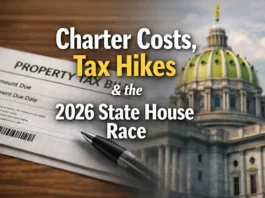
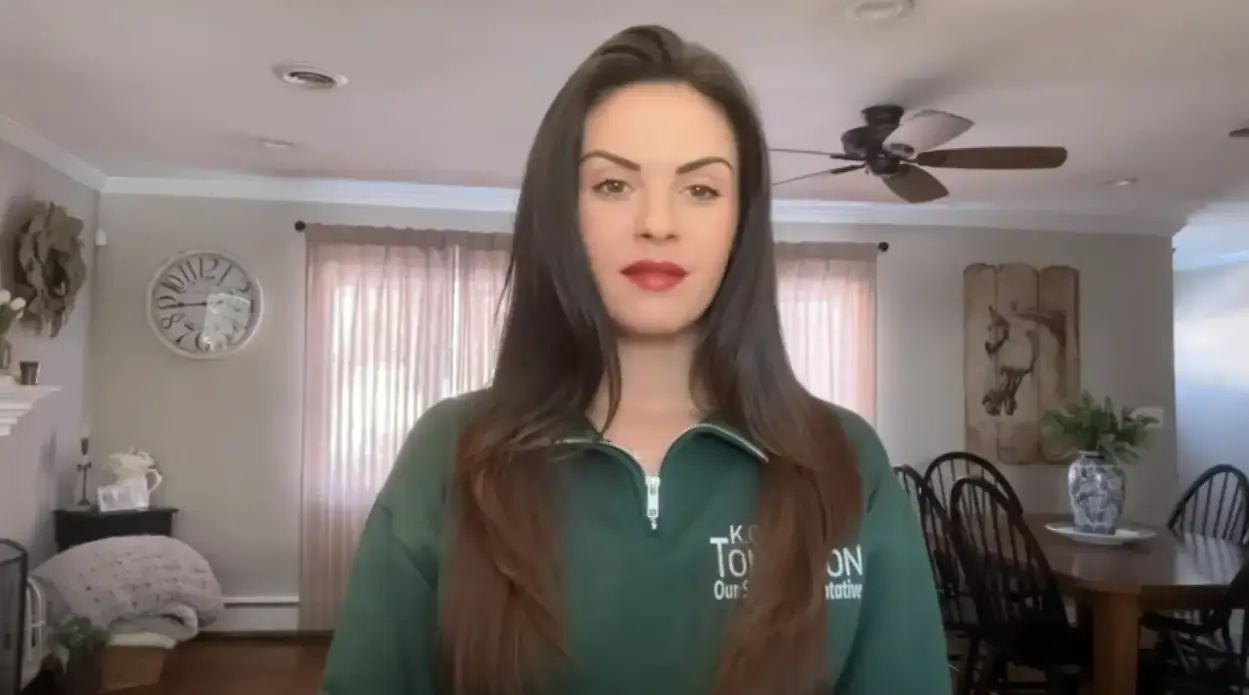
As Bensalem Township School District prepares to vote on a preliminary budget that includes an 8.26% property tax increase, State Rep. K.C. Tomlinson released a video defending her record on school funding and charter school reform.
In the video, Tomlinson says she has “consistently voted for charter school reform,” brought “record funding” to Bensalem schools, and argues she should not be blamed for a proposed tax hike because she does not serve on the school board.
This article examines her claims against:
- The district’s Proposed Preliminary General Fund Budget for FY 2026–2027
- Publicly available legislative records
- Charter funding law explanations from the Pennsylvania Department of Education
- Advocacy analysis from Children First PA
The Budget at the Center of the Debate
According to the district’s Proposed Preliminary General Fund Budget for FY 2026–2027, Bensalem is considering:
- An increase from 181.3315 mills to 196.3004 mills
- A 8.26% real estate tax increase
- Revenue above the Act 1 index (4.2%), totaling approximately $4.57 million
- An application for a Special Education Exemption
(Source: Bensalem Township School District preliminary budget documents)
The budget does not assign political blame. But district officials have publicly cited rising special education costs and charter tuition payments as significant financial pressures.
Claim: “I’ve consistently voted for charter school reform”
What’s accurate
Rep. Tomlinson voted in favor of HB 2370, a cyber charter reform bill that would cap cyber charter tuition rates statewide.
Coverage of the bill described it as one of the most significant cyber charter funding reforms in years:
- Chalkbeat: Pennsylvania Advances Big Changes for School Funding and Cyber Charters
- GovTech: PA House Passes Bill to Reform Cyber Charter School Funding
That vote aligns with her statement that charter schools can create financial strain for districts.
What requires context
Cyber charter reform is not the same as brick-and-mortar charter reform.
Under Pennsylvania’s charter funding law, districts must pay charter schools tuition based largely on district per-pupil spending calculations, implemented through PDE’s charter tuition rate calculation process (often referenced as PDE-363).
See:
PA Department of Education – Charter School Funding Overview
Rising special education tuition payments to brick-and-mortar charter schools have been cited locally as a key driver of current budget pressure.
Public sponsorship records should be reviewed to determine whether Rep. Tomlinson has served as a prime sponsor or co-sponsor of broader special education funding reform bills, such as proposals similar to HB 272 / SB 27 referenced in education advocacy reports.
Voting for reform legislation and leading reform efforts are distinct roles.
Claim: “Bensalem received $17.6 million in increased funding since I took office”
In her video, Tomlinson lists annual increases:
- 2021: $2.3 million
- 2022: $6.2 million
- 2023: $1.8 million
- 2024: $4.4 million
- 2025: $2.95 million
Those figures total approximately $17.6 million.
She also notes that governors of both parties signed budgets she supported.
What’s missing
The district is still facing an 8.26% proposed tax increase.
State funding increases and mandated charter tuition payments have grown simultaneously.
According to a Children First PA analysis of Bensalem Township School District, reforms similar to HB 272 / SB 27 could save the district approximately $2,089,691 annually.
The same report describes cyber charter tuition growth of roughly $2.012 million since 2020 as equivalent to about a 4.0% property tax increase, based on its methodology.
These are advocacy estimates, not audited district projections — but they illustrate the scale of charter-related cost growth relative to local tax pressure.
Claim: “I’m not on the school board… how those dollars are allocated and spent is solely up to the school board”
This is correct.
Rep. Tomlinson does not vote on the local millage rate. Property tax decisions are made by the nine elected school directors.
However:
The charter tuition formula is set by state law.
Local school boards cannot change how charter tuition is calculated.
Only the General Assembly can amend that funding structure.
The political debate centers on where responsibility begins and ends.
A Question of Tone — and Framing
Rep. Tomlinson’s video strongly emphasizes that she is not responsible for setting local taxes.
What the video does not clearly address is the structural issue at the heart of the district’s financial pressure:
- The special education funding formula
- The charter tuition calculation method
- Whether additional legislative reforms are needed beyond cyber charter caps
Instead of focusing primarily on defending against blame, the video may have benefited from acknowledging the complexity of the charter funding formula and outlining a clear forward-looking plan.
Voters often respond less to defensiveness and more to demonstrated understanding of systemic problems.
The Broader Context for Bensalem Voters
The facts:
- The proposed tax increase is 8.26%
- The district is applying for a Special Education Exemption
- Rep. Tomlinson voted for cyber charter reform
- Charter tuition formulas are determined at the state level
The unresolved question:
Has enough been done at the state level to address brick-and-mortar charter special education costs — and what should be done next?
That is ultimately a policy debate voters will weigh in the November 3, 2026 general election.