


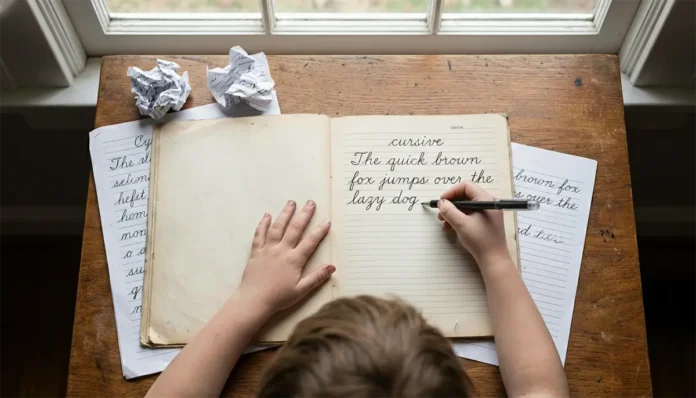
Heads up, everyone! Starting this fall, elementary schools across Pennsylvania—both public and private—will be teaching cursive again. House Bill 17, which passed in February 2026, makes it a state law. So, our younger students, including the K–4 kids in the Bensalem Township School District, will be learning how to connect those letters. Bensalem parents should be ready for more handwriting practice, some tweaks to class time, and maybe a few bumps in the road as we roll out this new rule.
What the new law actually does
Pennsylvania is bringing back cursive handwriting as a must-have subject in elementary schools across the state, thanks to the new House Bill 17 (now Act 2 of 2026). This law, which started in early 2026, revives a rule that the state got rid of around 2010.
Now, instead of letting local districts choose, this new rule makes cursive instruction a required elementary subject for both public and private schools, right alongside core subjects like reading and math.
The law keeps the details pretty broad, just requiring schools to “incorporate” cursive into the current writing curriculum. Importantly, the law doesn’t nail down specifics—like the exact grade level, how many minutes to teach it, or a specific program. So, it’s up to individual districts, like Bensalem, to figure out which grades will focus on cursive, how much practice students will get, and how it will be graded, all while staying within the new state guidelines.
What Bensalem K–4 parents will see day to day
For Bensalem K–4 families, the most obvious shift will show up inside the English Language Arts (ELA) block. Instead of cursive being something only some teachers decide to squeeze in, parents should expect clearly defined cursive lessons starting in the early grades, most likely in grades 2–4, when students’ fine motor skills are ready for more complex handwriting. Children will spend portions of their ELA time learning how to form cursive letters, connect them into words, and eventually write full sentences and signatures.
This will almost certainly mean more handwriting practice coming home. I think parents can expect to see traditional lined worksheets, practice assignments, and short “copy this sentence in cursive” work showing up in folders. Teachers may ask students to sign their names in cursive on class materials or write short notes in cursive once students have learned the basics. Over time, report cards or progress reports may start to mention “handwriting/cursive” explicitly, rather than vague “writing” comments, as teachers are asked to show they have met the new state requirement.
Legally, districts don’t have to provide retroactive cursive instruction for kids who are already past elementary school. That means middle and high schools aren’t required to offer those catch-up classes, though they can if they want to. For Bensalem families whose older children missed out, that gap in education will stick around unless the district decides to step in and offer a fix.
Why supporters pushed for cursive
The new law about teaching cursive is a big win, according to the people who pushed for it—the bill’s sponsors and teachers who kept it in the curriculum. They argue that learning cursive actually fires up important parts of the brain, giving a real boost to memory, focus, and fine motor skills. This whole process helps with reading and literacy in general. So, for Bensalem students, cursive isn’t just about fancy handwriting; it’s a solid method for improving their reading and writing skills.
On the practical side, backers emphasize that kids should be able to sign their names on legal and financial documents and read cursive in historical texts, older family letters, or handwritten notes. References to documents like the Declaration of Independence and the U.S. Constitution come up frequently in public comments, with lawmakers arguing that students should be able to read these in their original form, not just as typed transcriptions. For parents, this gives a practical application: your child is learning a skill that still matters whenever they open a bank account, sign a permission form, or come across an old family letter.
The crowded-day problem: where does the time come from?
The first major pain point for Bensalem families is simple: nothing about the law extends the school day. Teachers are expected to add something new to a schedule that is already packed with reading, math, science, social studies, and interventions for students who need extra help. So the time for cursive has to come from somewhere.
Usually, teachers squeeze in cursive lessons during the regular English Language Arts (ELA) time. This means they often have to cut back on other reading and writing stuff—like reviewing print handwriting, doing certain writing assignments, or independent/small-group reading—to make room for handwriting practice. While the day-to-day difference might not seem huge, parents might notice that on “cursive days,” there’s less time for other literacy work. This adds up over the school year, and it’s something that worries some teachers and parents, especially since everyone’s trying to catch up on learning lost since the pandemic.
Bensalem K–4 parents should really think about what’s getting the boot for cursive. It’s a much bigger deal if cursive cuts into basic phonics or crucial small-group reading time than if it just takes the place of boring print handwriting practice or pointless busywork.
Uneven experiences between classrooms
Because the law is pretty open-ended and leaves a lot of decisions up to the local schools, the way it plays out probably won’t be identical in every Bensalem classroom. Some teachers already love cursive and know how to teach it well. They’ll likely set up clear routines, give the kids consistent practice, and offer helpful feedback. Other teachers might not feel as sure about it or might see it as just another thing piled on top of everything else they have to teach. That could mean the instruction is minimal or just all over the place.
This uneven approach could mean very different experiences for the kids. In Bensalem, one third grader might get a great, solid cursive program with lots of chances to practice, while another might only get a couple of rushed lessons. That, in turn, can create a real skill gap as they move up: some will hit fourth or fifth grade feeling comfortable with cursive, and others will barely be able to read it.
For parents, this is your cue to really listen to what your child is saying and look closely at their schoolwork. If the expectations seem confusing or inconsistent—like one classroom is super focused on neatness and another barely mentions it—that’s definitely something worth chatting with teachers or administrators about. The law’s flexibility is a good thing, but it also means parents need to keep an eye on things.
Students who struggle with handwriting
Another predictable friction point is for children who already find handwriting hard—students with dysgraphia, fine motor delays, ADHD, autism, or other learning and physical differences that affect handwriting. For these children, adding cursive can feel like adding a whole other layer of frustration, especially if neatness or speed is heavily emphasized.
The law doesn’t erase existing protections under federal disability laws. Students with IEPs or 504 plans are still entitled to accommodations and individualized expectations, which can include adjustments to cursive instruction and grading. For example, a student might practice cursive for exposure but not be required to use it for long written assignments, or their grade might focus on effort and legibility rather than speed and perfection. For Bensalem parents of students with special needs, a practical step will be to ask at IEP or 504 meetings how cursive will be handled so that it supports, rather than undermines, broader goals like functional communication and confidence.
Motivation and the “one more thing” feeling
The new cursive law is getting a mixed reaction from students around the state. Some kids think it’s “fun” or “fancy,” while others find it “weird,” “hard to read,” or just another thing they’ll be graded on. We’ll likely see that same mix of opinions in our own classrooms.
For K–4 parents, the key is to keep practice at home relaxed and practical. Instead of drilling endless lines of letters, try short, real-world tasks. Think: signing their name on a little “certificate,” jotting a quick note to a relative, or labeling a picture in cursive. If cursive just adds to the stress of tests and homework, kids might push back, and that defeats the whole purpose of the law.
Smart questions for Bensalem K–4 parents
Since a lot of the specifics are decided at the local level, Bensalem parents will get the best results by asking concrete, practical questions instead of just debating the idea of cursive generally. Here are some helpful questions to bring up with teachers, principals, or school board members:
- Which grades in Bensalem are going to teach cursive, and when will it happen during the school year? Is there a clear plan to make sure every student gets similar instruction?
- How will cursive be graded on report cards—will it be a separate grade for handwriting, part of the writing grade, or just mentioned in teacher comments?
- For kids with IEPs or 504 plans, how will the cursive expectations and grading be adjusted to be fair and consistent with the help they already get?
- What will be cut back or combined in the ELA block to make room for cursive, and how will the district ensure that important reading and writing skills aren’t neglected?
FAQ
Q: Does Pennsylvania require cursive in schools?
A: Yes. Governor Josh Shapiro signed House Bill 17 into law on February 11, 2026. The law, now Act 2 of 2026, requires all public and private elementary schools in Pennsylvania to incorporate cursive handwriting into their writing curriculum. It takes effect 60 days after signing.
Q: What grades will learn cursive in Bensalem?
A: The law does not specify exact grades, leaving that to local districts. In Bensalem, cursive instruction will most likely be concentrated in grades 2–4, when students’ fine motor skills are ready for connected handwriting.
Q: Will cursive be graded in Bensalem schools?
A: The law requires cursive to be part of the curriculum, but does not mandate specific grading. Parents can expect report cards or progress reports to begin mentioning handwriting or cursive proficiency as the district updates its ELA standards.
Q: Does the cursive law apply to students with IEPs or 504 plans?
A: The law does not override federal disability protections. Students with IEPs or 504 plans are still entitled to accommodations, which can include adjusted expectations for cursive instruction and grading.
Q: Do older Bensalem students have to learn cursive, too?
A: No. The law focuses on elementary schools and does not require middle or high schools to retroactively teach cursive, though districts can offer it if they choose.