
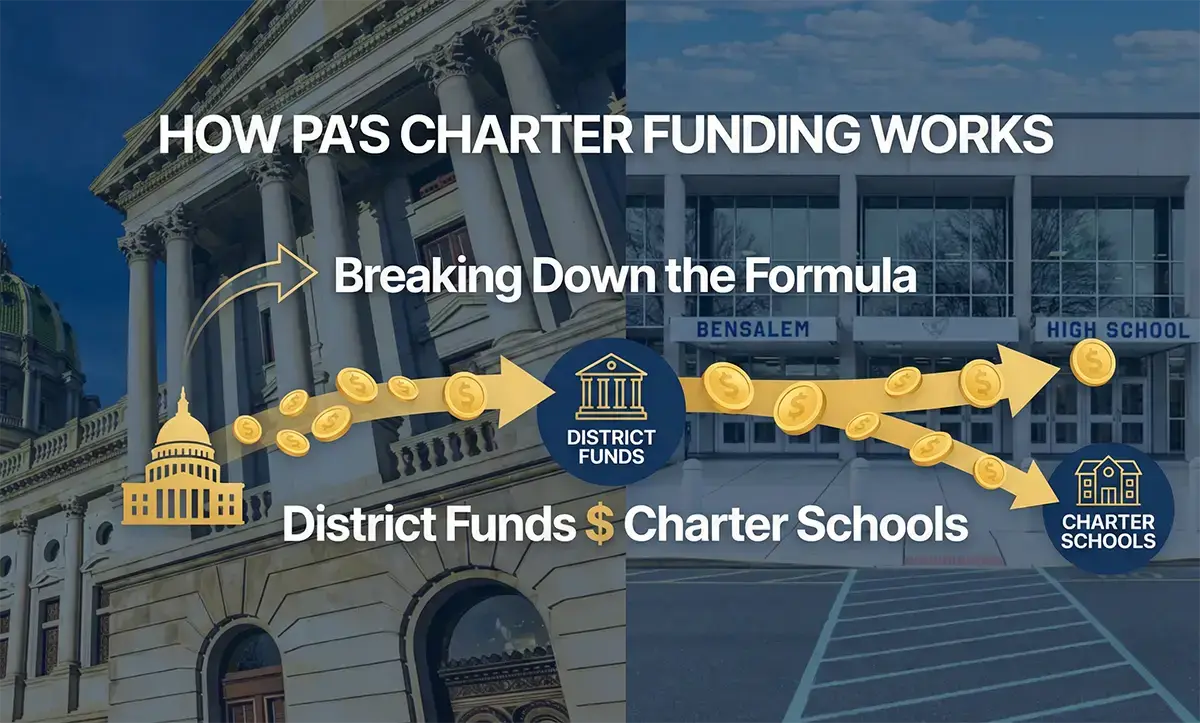
Pennsylvania funds charter schools through a state-mandated tuition formula that requires each student’s home school district to pay a per-pupil amount for every resident student who enrolls in a charter or cyber charter school.
That formula — found in Section 1725-A of the Pennsylvania Public School Code — plays a central role in school district budgets across the Commonwealth, including in Bensalem Township.
Here’s how it works.
The Legal Framework
Charter school funding rules are outlined in Section 1725-A of the Pennsylvania School Code.
Charter schools do not charge families tuition. Instead, a student’s home school district is legally obligated to send tuition payments to the charter school for each enrolled resident student.
If a district fails to pay, the Pennsylvania Department of Education (PDE) can redirect state subsidy funds directly to the charter school.
The Core Concept: District-Based Tuition Rates
Each school district calculates its own charter tuition rate based on its prior-year spending.
The calculation is done using PDE Form 363, which determines a district’s “selected expenditures per average daily membership (ADM).”
Because each district’s spending differs, the tuition rate paid for a charter student varies depending on where that student lives.
This means:
- The same charter school may receive different tuition amounts for students from different districts.
- Tuition rates reflect district averages, not the charter school’s actual cost structure.
What Costs Are Included — and Excluded
The formula excludes certain costs that charter schools typically do not incur, such as:
- Transportation
- Adult education
- Some services to nonpublic schools
- Facilities construction and debt service
- Federal funds (since charters can apply for federal aid directly)
The result is a regular education tuition rate and a separate special education tuition rate for each district.
Regular vs. Special Education Rates
Every district generates at least two charter tuition figures:
- A nonspecial-education per-pupil rate
- A special-education per-pupil rate
The special education rate is calculated by dividing a district’s total special education spending by the total number of special education students.
This creates a single districtwide average for special education students.
It does not adjust tuition based on the individual student’s specific disability tier or cost level.
How Special Education Tiers Work
Pennsylvania categorizes special education students into three tiers based on the level of support required:
- Tier 1 – Minimal support services
- Tier 2 – Moderate support services
- Tier 3 – Intensive support services
While districts track these tiers for state reporting purposes, the charter tuition formula does not pay different rates for each tier. It pays a single, averaged special-education rate per district.
The Actual Formula (Simplified)
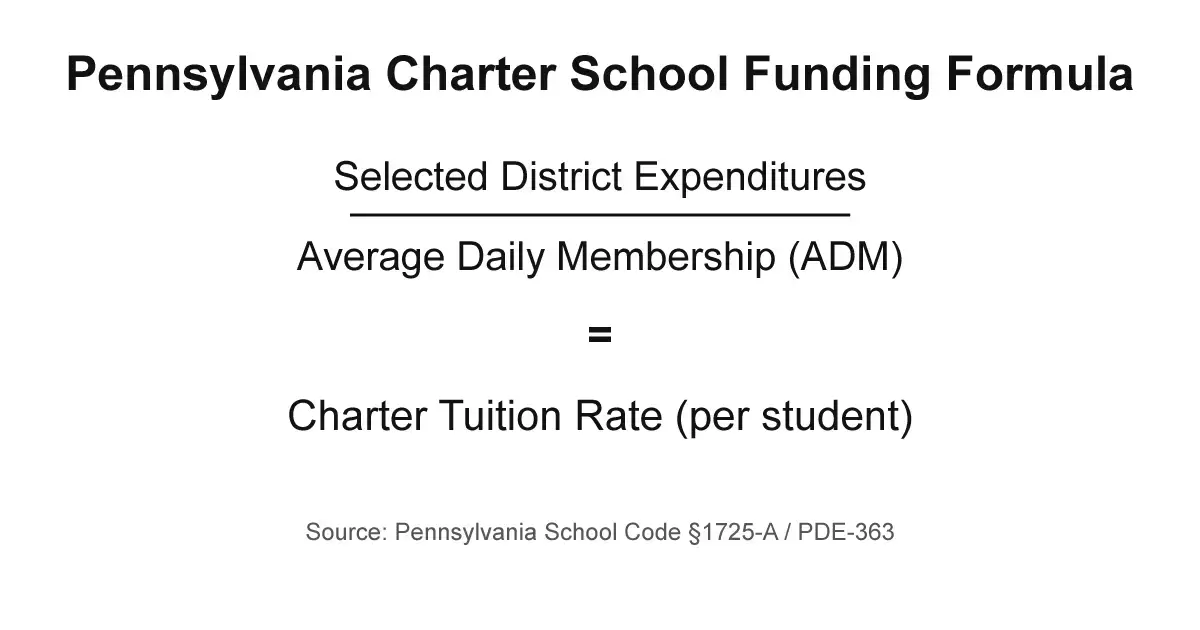
Under Section 1725-A of the Pennsylvania School Code, a district’s charter tuition rate is calculated using prior-year financial data.
The simplified formula for regular education tuition is:
Charter Tuition Rate =
(Selected District Expenditures ÷ Average Daily Membership)
Where:
- Selected District Expenditures = Total instructional and support costs (minus excluded items like transportation, facilities debt, adult education, and certain federal funds)
- Average Daily Membership (ADM) = Total number of students enrolled in the district
Special Education Formula
The special education tuition rate is calculated differently depending on the type of charter school.
For brick-and-mortar charter schools, state law requires districts to divide total special education expenditures by 16% of total district enrollment, regardless of the district’s actual percentage of special education students.
Beginning in January 2025, cyber charter schools use the district’s actual number of special education students as the divisor when calculating special education tuition.
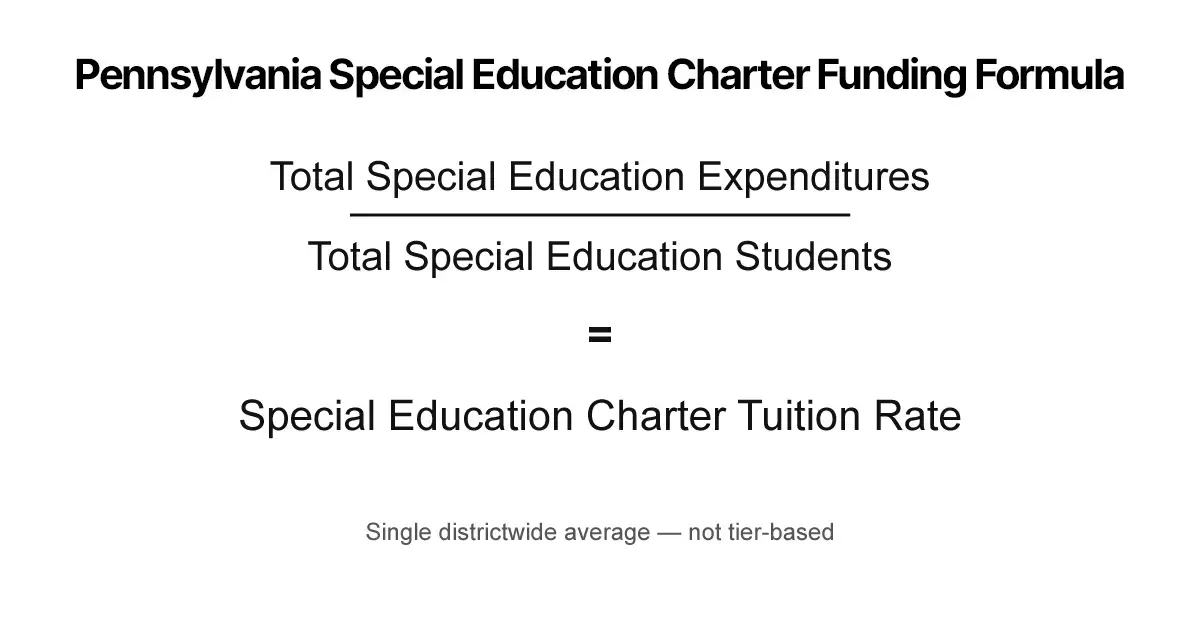
The special education charter tuition rate is calculated as:
Special Education Charter Rate =
(Total Special Education Expenditures ÷ Total Special Education Students)
This produces a single districtwide average special education tuition rate.
Importantly:
The formula does not calculate tuition based on an individual student’s disability tier. It applies the districtwide average to each special education student enrolled in a charter school.
Example: How the Math Works
Here’s a simplified example to illustrate how it functions.
Regular Education Example
If a district reports:
- $120,000,000 in selected expenditures
- 6,000 students (ADM)
Then:
$120,000,000 ÷ 6,000 = $20,000 per student
The district would pay approximately $20,000 per regular education student enrolled in a charter school.
Special Education Example
If that same district reports:
- $30,000,000 in total special education spending
- 1,000 special education students
Then:
$30,000,000 ÷ 1,000 = $30,000 per student
The district would pay approximately $30,000 per special education student enrolled in a charter school.
That payment applies regardless of whether the student falls into a lower-cost Tier 1 category or a higher-cost Tier 3 category.
Why the Math Matters
Because the formula is based on district averages:
- Higher district spending increases the charter tuition rate.
- Increases in special education spending increase the charter special education rate.
- Enrollment growth multiplies the total payment obligation.
Local school boards do not calculate new tuition rates by negotiation — they apply the state formula to prior-year financial data.
That is why changes in enrollment, spending levels, or state law can directly affect district budgets and property tax discussions.
Cyber Charter Funding: What Changed in 2025–26
Historically, cyber charter schools were funded using the same district-based formula as brick-and-mortar charter schools.
During 2025–26 state budget negotiations, lawmakers debated establishing a flat statewide cyber tuition rate. That proposal was not enacted into law.
Instead, the final budget expanded allowable deductions in the cyber charter tuition calculation process and modified elements of the funding structure, resulting in reduced payments statewide.
The budget also changed how cyber charter special education tuition is calculated, shifting to actual special education enrollment as the divisor beginning in January 2025.
Brick-and-mortar charter schools continue to follow the district-based formula, including the 16% special education assumption.
Why This Matters for Local Budgets
Because charter tuition rates are set by state law, local school boards cannot:
- Refuse payment
- Negotiate tuition rates
- Cap charter enrollment
- Change the formula
If enrollment increases or if a district’s calculated tuition rate rises, total charter payments increase accordingly.
School boards must then adjust budgets using the tools available to them:
- Local tax rates (within Act 1 limits)
- Program adjustments
- Use of reserves
The charter tuition formula is therefore directly connected to local school district budget discussions and property tax decisions.
Ongoing Policy Debate
Over the past decade, lawmakers from both parties have introduced proposals to:
- Adjust special education reimbursement methods
- Account for district fixed costs
- Create tier-based special education payments
- Further reform cyber charter funding
Some reforms have passed. Others have stalled in committee.
Because the funding formula is codified in state law, any major changes require action by the Pennsylvania General Assembly.
Bottom Line
Pennsylvania’s charter school funding formula is built around district averages, not individual student costs.
That structure means charter tuition payments vary widely across districts and can have significant budget impacts depending on enrollment levels.
Understanding the formula helps explain why state legislative decisions can directly affect local school budgets and property taxes.
Related Coverage
- School Budget Crisis Hits as Bensalem’s Political Landscape Shifts
- Meet K.C. Tomlinson
- Meet Bryan Allen
- Bensalem 18th District Election Hub
Editor’s Note (Correction)
This article has been updated to clarify two points regarding Pennsylvania’s charter school funding formula.
First, while a proposal to establish a flat $8,000 statewide tuition rate for cyber charter schools was introduced during budget negotiations, that cap was not enacted into law. Instead, the 2025–26 budget reforms expanded allowable deductions for districts when calculating cyber charter tuition, resulting in reduced payments statewide.
Second, this article previously described special education charter tuition as being calculated using actual special education enrollment figures. While that approach now applies to cyber charter schools beginning January 2025, brick-and-mortar charter schools continue to use a statutory 16% special education enrollment assumption as the divisor in calculating tuition payments.
We appreciate the clarification provided by Education Voters of PA and have updated the article to reflect these distinctions.