
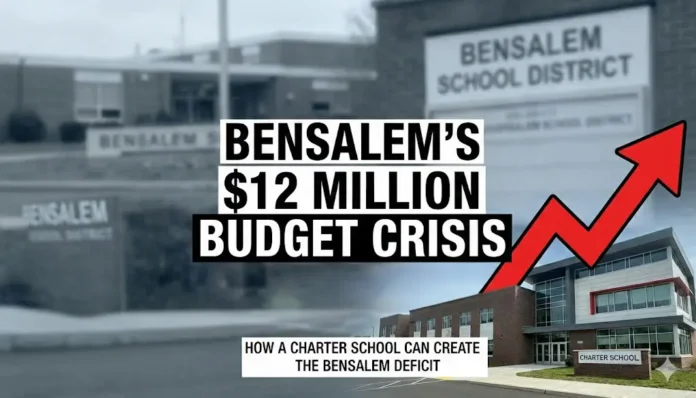
The Bensalem School Board gathered on January 14, 2026, to discuss what Business Administrator John Steffy called “a significant budget challenge.”
That was putting it mildly.
The district faces a deficit between $6.5 million and $12.1 million for the 2026-27 school year, depending on enrollment projections. To close the gap, administrators proposed an 8.25% property tax increase—the largest in recent memory.
For the owner of a median-value Bensalem home, that means an additional $347 per year in school taxes—about $29 per month.
But here’s what made the January 14 meeting different from typical budget crises: the problem isn’t declining enrollment, aging buildings, or runaway benefit costs.
The culprit is special education—specifically, a dramatic and sudden spike in special education students at School Lane Charter School.
The September Surprise
In September 2024, School Lane Charter School reported 58 special education students from Bensalem Township.
By January 2025—just four months later—that number had jumped to 109.
That’s an 88% increase in special education enrollment at a single charter school in a single semester.
And because of how Pennsylvania funds charter schools, Bensalem School District is legally required to pay School Lane for every one of those students—at rates calculated using the district’s own, much higher special education costs.
The result? Bensalem’s preliminary budget for 2026-27 shows charter school special education payments nearly doubling, from $7.4 million to $14.6 million.
That’s a $7.2 million increase in one line item, in one year.
To put that in perspective: the charter payment increase alone accounts for 79% of the district’s total special education spending growth, which jumped from $41.8 million to $50.9 million—a 21.7% increase.
“We’ve never seen anything like this,” one school board member said during the January meeting.
But to understand why this is happening—and why Pennsylvania’s charter school funding formula makes it nearly impossible to prevent—you need to understand what I call the Whammy Trifecta.
Three separate but compounding structural problems in Pennsylvania’s charter school law that turn special education funding into a fiscal time bomb for districts like Bensalem.
WHAMMY #1: Enrollment Arbitrage Drives Up District Costs
Here’s how charter school funding works in Pennsylvania:
When a student leaves a traditional public school to attend a charter school, the district must pay the charter a per-student tuition rate.
For regular education students, that rate is based on the district’s average spending per student.
For special education students, the rate is also based on the district’s average—but the average includes the cost of all special education students, including the most expensive ones.
This creates what economists call “adverse selection”—or what I call enrollment arbitrage.
The Math That Doesn’t Work
Not all special education students cost the same to educate.
Pennsylvania categorizes special education students into three tiers based on the level of support they need:
Tier 1 students need minimal support—perhaps speech therapy or extra time on tests. These students might cost $15,000–$20,000 per year to educate.
Tier 2 students need moderate support—specialized instruction, classroom aides, occupational therapy. These students might cost $30,000–$50,000 per year.
Tier 3 students need intensive, often one-on-one support—students with severe disabilities, profound medical needs, behavioral crises. These students can cost $75,000–$150,000 per year or more.
But Pennsylvania’s charter school funding formula doesn’t distinguish between these tiers.
Instead, it takes the district’s total special education spending and divides it by the total number of special education students to create a single average rate.
For Bensalem, that average is approximately $38,000 per special education student (calculated from the $41.8 million in special education spending in the 2025-26 budget).
The Arbitrage Opportunity
Now here’s where the incentive structure breaks down.
If School Lane enrolls mostly Tier 1 students (the least expensive to serve), but receives payments based on Bensalem’s average (which includes expensive Tier 2 and Tier 3 students), School Lane gets paid far more than it costs to educate those students.
Let’s say School Lane enrolls a Tier 1 student who needs $18,000 worth of services.
Bensalem pays School Lane $38,000 (the district average).
School Lane pockets a $20,000 spread.
Meanwhile, Bensalem is left serving a higher concentration of Tier 2 and Tier 3 students—the expensive ones—which drives up the district’s per-pupil average even higher for next year.
Which means School Lane gets paid even more for the low-cost students it enrolls the following year.
It’s a fiscal death spiral.
The Evidence Gap
Pennsylvania doesn’t require charter schools to report tier-by-tier special education enrollment. The state tracks total special education numbers, but not whether charter schools primarily serve low-cost Tier 1 students while districts retain expensive Tier 2 and Tier 3 students.
Bensalem Weekly has filed a Right-to-Know request with the school district seeking this breakdown for both Bensalem schools and School Lane Charter. That data should reveal whether the 51 new special education students at School Lane are primarily low-cost or high-cost to serve.
For now, what we know is this: School Lane’s special education enrollment jumped 88% in four months, and Bensalem’s budget shows a corresponding $7.2 million increase in charter payments.
Whether that enrollment consists primarily of low-cost or high-cost students will determine whether this is simply rapid growth—or financial engineering.
WHAMMY #2: The Selection Problem
Even if School Lane isn’t deliberately selecting low-cost students, Pennsylvania’s charter school system creates powerful incentives for families with easier-to-serve special needs students to self-select into charter schools.
School Lane has two campuses in Bensalem, but transportation, accessibility, and program structure all affect which families can realistically choose charter schools.
Transportation barriers: Students with complex medical needs may require specialized vehicles with lifts, trained medical aides, or specific equipment. Charter school transportation may not accommodate these requirements.
Physical accessibility: Students with significant mobility challenges need buildings designed for wheelchairs, adaptive equipment, and accessible facilities throughout.
Program intensity: Families with Tier 3 students—those requiring intensive one-on-one support, behavioral specialists, or full-time medical care—may find that traditional public schools offer more comprehensive services.
Enrollment processes: Charter schools have application procedures, lotteries, and enrollment windows. Families dealing with crisis-level behavioral or medical issues may not have the bandwidth to navigate these processes.
The result is a system where lower-cost special education students flow toward charter schools, while higher-cost students remain in traditional districts—without anyone explicitly discriminating.
It’s structural segregation by cost, built into how the system works.
WHAMMY #3: The Funding Formula Trap
But even if we solved the tier distribution problem—even if charter schools served the exact same mix of Tier 1, 2, and 3 students as traditional districts—Bensalem would still face a budget crisis.
Because Pennsylvania’s charter funding formula has a fundamental flaw: it assumes that when students leave for charter schools, the district’s costs decrease proportionally.
They don’t.
Fixed vs. Variable Costs
Let’s say Bensalem has 100 students in a school with 5 teachers.
If 10 students leave for School Lane Charter, does Bensalem eliminate 0.5 teachers?
No. You can’t fire half a teacher.
You still need 5 teachers for the remaining 90 students—at least until enrollment drops enough to close an entire classroom or building.
This is true across the budget:
Fixed costs that don’t decrease:
- Building maintenance and utilities (unless you close a building)
- Administrative staff (superintendent, business office, HR)
- Transportation (unless you eliminate entire routes)
- Insurance and debt service
- Technology infrastructure
Variable costs that decrease (somewhat):
- Classroom supplies
- Food service (for departed students)
- Some instructional materials
But the charter funding formula treats everything as if it’s variable.
When 10% of students leave, the district loses 10% of its revenue—even though it can’t cut 10% of its costs.
The Special Education Multiplier
This problem is even worse for special education because special ed costs are heavily fixed.
Consider a student with autism who requires:
- A specialized classroom with sensory accommodations
- A dedicated behavioral aide
- Speech therapy twice a week
- Occupational therapy once a week
- Transportation with a trained aide
If that student leaves for School Lane, Bensalem loses the $38,000 tuition payment.
But does Bensalem eliminate:
- The specialized classroom? (No—other students use it)
- The behavioral aide? (Maybe, if that was their only student)
- The speech therapist? (No—they serve multiple students)
- The OT? (No—they serve multiple students)
- The specialized transportation? (Maybe, if the route becomes inefficient)
At best, Bensalem might save 20-30% of the cost.
But it loses 100% of the revenue.
The 51-Student Catastrophe
Now multiply that by 51 students—the number of special education students School Lane added in four months.
Even if Bensalem could eliminate some costs, it’s losing $1.9 million in revenue ($38K × 51) while saving perhaps $600K in eliminated services.
That’s a $1.3 million net loss—money that has to be made up somewhere.
And “somewhere” is property taxes.
Who Pays? Who Profits?
The Bensalem School Board will vote on February 18, 2026, on whether to approve the 8.25% property tax increase.
If it passes, here’s what that means for real families.
The Tax Bill
The median assessed home value in Bensalem is $23,200.
At the current millage rate of 181.3315 mills, the owner of a median-value home pays approximately $4,207 per year in school property taxes.
An 8.25% increase adds $347 per year to that bill—or about $29 per month.
That may not sound catastrophic. But for families already stretching to afford housing in Bucks County, that’s:
- One week’s worth of groceries
- Half a monthly car insurance payment
- Two tanks of gas
- The difference between making rent on time or juggling bills
And it’s happening against the backdrop of three years of broader cost increases—inflation in food, utilities, insurance, and healthcare that have already strained household budgets.
For many families, $347 is the proverbial straw that breaks the camel’s back.
Renters vs. Homeowners
The pain isn’t distributed equally.
Property taxes don’t just hit homeowners—they hit renters too, as landlords pass increases through to tenants.
In Bensalem, 29.2% of households rent rather than own. That’s roughly 7,100 renter households.
These residents—disproportionately lower-income families, young workers, and seniors on fixed incomes—will absorb the tax increase as a rent hike with none of the offsetting benefits homeowners receive:
- No property tax deductions on federal returns
- No Homestead Exemption ($1,862 in property tax relief for owners)
- No long-term equity appreciation to offset the cost
They just pay more rent.
Fixed-Income Seniors
Bensalem has 10,831 residents over age 65—nearly one in five residents.
Many live on fixed incomes from Social Security and pensions that barely keep pace with inflation, let alone 8.25% property tax increases.
For a senior homeowner who bought their house decades ago and paid off the mortgage, property taxes are often their single largest housing expense.
Pennsylvania’s Property Tax/Rent Rebate Program offers some relief, but it’s inadequate:
- Maximum rebate: $650 for homeowners
- Income limit: $35,000 for homeowners
- Application required: Annual paperwork, often confusing
That $650 rebate doesn’t come close to covering a $347 annual increase.
And for seniors who earn just above the $35,000 threshold—perhaps from a small pension or part-time work—they get nothing.
Working Families
Bensalem’s median household income is $79,717.
For working families at or near that median—the ones who moved here for good schools and affordable housing compared to wealthier Bucks County townships—an 8.25% property tax increase compounds other financial pressures.
In the past three years, these families have absorbed:
- Food costs up 20%+ since 2022
- Car insurance premiums up 26% in Pennsylvania (2023-2024)
- Home insurance up 15%+
- Healthcare premiums rising annually
- Utility costs increasing with rate hikes
Now add $347 in school taxes.
For a family earning $80,000, that’s not a rounding error. That’s real money coming out of an already-tight budget.
At some point, families start making hard choices:
- Do we stay in Bensalem, or move to a cheaper township?
- Do we cut kids’ activities to afford the tax bill?
- Do we defer home repairs another year?
- Do we pull from savings meant for college or retirement?
The Geography of Pain
The tax increase hits hardest in Bensalem’s most affordable neighborhoods—the very communities that can least afford it.
A homeowner with a median-assessed property ($23,200) pays an extra $347.
But a homeowner with a higher-assessed property ($40,000) pays an extra $600.
And a homeowner in one of Bensalem’s pricier areas ($60,000 assessed value) pays an extra $900.
In dollar terms, wealthier homeowners pay more.
But as a percentage of income, lower-income families bear the heavier burden.
A $347 increase for a family earning $50,000 is 0.69% of their annual income.
A $900 increase for a family earning $150,000 is 0.60% of their annual income.
Property taxes are regressive—they take a bigger bite from those who can least afford it.
The Irony of School Choice
Here’s the bitter irony: many Bensalem families can’t even access the charter schools their tax dollars are funding.
School Lane Charter School has two campuses in Bensalem—but several miles from many residential neighborhoods. The district provides transportation to charter schools, but:
Transportation barriers:
- Bus routes may not serve all areas efficiently
- Pickup times may be earlier than district schools
- Parents need reliable transportation for missed buses
- After-school programs require parent pickup
For working parents who rely on walkable neighborhood schools and after-school care, charter schools aren’t a realistic option.
For families with special needs students who require specialized transportation—vehicle lifts, trained aides, medical equipment—charter school transportation may not meet their needs.
So these families pay higher property taxes to fund a system they can’t access, while watching their neighborhood schools lose resources.
Who Profits?
While Bensalem families absorb an 8.25% tax increase, someone else is making money.
School Lane Charter School: Who They Are
School Lane Charter School is a 501(c)(3) nonprofit organization—which means it has no private owners or shareholders in the traditional sense.
Instead, it’s governed by a nine-member Board of Trustees:
Board Leadership:
- Surya Vedula, President
- Ed Guster, Vice President
- Bharvin Patel, Treasurer
- Kelly McGee, Secretary
- Plus five additional board members
Executive Team:
- Karen A. Schade, Chief Executive Officer – $210,300 base salary
- David Robinson, Principal (Elementary Campus) – $168,850
- Colette Weber, Principal (IB Campus) – $150,630
- Michelle Stride, Director of Special Education – $136,100
According to School Lane’s most recent IRS Form 990 filing (fiscal year ending June 30, 2024):
Total Revenue: $27.2 million
Total Expenses: $23.1 million
Total Assets: $58.7 million
Staff: Approximately 235 employees
That’s roughly $43,800 in assets per student enrolled—far more than most traditional public schools can claim.
The Real Estate Shell Game
As a nonprofit, School Lane can’t distribute profits to shareholders. But that doesn’t mean there’s no money to be made.
In 2013, Pennsylvania’s Auditor General flagged School Lane for “improperly collecting $60,248” through the state’s charter school lease reimbursement program.
The audit uncovered what investigators called a “circular leasing structure”:
- In April 2006, School Lane created a separate entity called the School Lane Foundation
- In 2007, School Lane sold its building to the School Lane Foundation
- School Lane then leased the building back from its own foundation—and billed Pennsylvania taxpayers for the lease payments through the state’s lease reimbursement program
- In 2010, the School Lane Foundation sold the building back to School Lane for $1
The entire transaction cycle allowed School Lane to claim state reimbursements for “lease payments” it was essentially paying to itself.
School Lane disputed the Auditor General’s findings, arguing that the Pennsylvania Department of Education had approved the reimbursements. The school eventually merged the foundation back into the main organization and discontinued the structure.
No one was prosecuted. No penalties were assessed. The disputed funds were never repaid.
The system worked exactly as designed: charter schools maximize revenue, state auditors eventually notice, charter schools dispute the findings, everyone moves on.
Where Does Bensalem’s $7.2 Million Go?
When Bensalem’s charter payments jumped from $7.4 million to $14.6 million, that $7.2 million increase went to School Lane.
Some of that money funds legitimate educational services for the 51 additional special education students School Lane enrolled between September 2024 and January 2025.
But here’s the math that should concern Bensalem taxpayers:
What Bensalem pays School Lane per special ed student:
Approximately $38,000 (based on the district’s average special education cost)
What it costs to serve a Tier 1 special education student:
Approximately $18,000-$20,000 (speech therapy, accommodations, minimal support)
The potential spread per student: $18,000-$20,000
If even half of School Lane’s 51 new special education students are Tier 1 students (the least expensive to serve), that’s a potential gap of:
25 students × $19,000 spread = $475,000 in surplus revenue
That’s nearly half a million dollars Bensalem taxpayers could be sending to School Lane beyond what it costs to educate those students.
Where does surplus revenue go at a nonprofit charter school?
- Executive compensation? (CEO salary: $210,300)
- Facility improvements and real estate investments?
- Building the $58.7 million asset base?
- Marketing to recruit more students?
Pennsylvania doesn’t require charter schools to provide detailed accounting of how special education funds are spent, so taxpayers can’t verify whether their money is being used efficiently.
The Charter School Industry
School Lane isn’t unique.
Pennsylvania has over 170 charter schools serving more than 135,000 students, with total funding exceeding $2 billion annually.
Many are operated by nonprofit organizations that pay substantial salaries to executives and contract with for-profit vendors for real estate, management services, and educational technology.
The special education funding formula creates particularly strong financial incentives because:
- High reimbursement rates (based on district averages including expensive students)
- Potentially lower costs (if you primarily serve less expensive students)
- Limited oversight (PDE doesn’t track tier-by-tier enrollment)
This isn’t a bug in the system. It’s a feature.
The charter school law was written this way—with heavy lobbying from charter advocates—and has remained largely unchanged since 1997 despite repeated complaints from school districts.
The Equity Question
Bensalem’s budget crisis raises a fundamental question about educational equity:
Should Pennsylvania’s education funding system allow asset accumulation at charter schools while leaving traditional districts to serve the most expensive, most challenging students with ever-shrinking resources?
Special education exists because we decided, as a society, that students with disabilities deserve a free and appropriate public education.
The Individuals with Disabilities Education Act (IDEA) and Pennsylvania’s Chapter 14 regulations guarantee these students’ rights—and require districts to provide whatever services students need, regardless of cost.
That’s the right moral framework.
But Pennsylvania’s charter funding formula undermines it by creating incentives to serve lower-cost students while leaving the most expensive ones to traditional districts.
The result is a two-tiered system:
Tier One: Charter schools that can be selective (through enrollment processes, location, transportation, accessibility) potentially serve a disproportionate share of lower-cost students while collecting payments based on the district average. They accumulate assets, build cash reserves, and pay competitive executive salaries.
Tier Two: Traditional public schools serve whoever walks through the door—including every student the charters won’t or can’t accommodate—with declining per-pupil resources as charter payments drain the budget.
This isn’t “school choice.”
It’s cost-shifting.
And Bensalem taxpayers are footing the bill.
The Special Education Students Caught in the Middle
Lost in the budget spreadsheets and political fights are the 51 students at the center of this crisis.
These are real kids with real needs:
- Children with dyslexia learning to read
- Students with ADHD learning to focus
- Kids with autism learning social skills
- Teenagers with anxiety learning to manage stress
They deserve excellent special education services.
The question is: should Bensalem taxpayers pay $38,000 per student to School Lane when the actual cost to educate some of those students might be $18,000?
And should the district’s most expensive students—kids with profound disabilities, severe medical needs, or complex behavioral challenges—be left with fewer resources as charter payments consume a growing share of the budget?
Pennsylvania’s charter funding formula says yes.
But that doesn’t make it right.
How We Got Here: The Political Economy of Charter School Funding
Bensalem’s budget crisis didn’t happen by accident.
It’s the predictable result of a charter school funding formula that has remained fundamentally unchanged since Pennsylvania’s Charter School Law was enacted in 1997—nearly three decades ago.
The law has survived this long not because it works well, but because it serves powerful interests.
The 1997 Compromise
When Pennsylvania passed its charter school law in 1997, it faced a fundamental tension:
Charter schools needed enough funding to operate independently.
But traditional school districts needed to retain enough resources to serve the students who remained—including the most expensive ones.
The compromise was simple: charter schools would receive per-pupil payments based on the sending district’s average costs.
This seemed fair in theory. If it costs a district $15,000 per student on average, why shouldn’t a charter school receive $15,000 to educate that student?
But the formula contained a fatal flaw: it assumed all students cost the same to educate.
They don’t.
The Special Education Multiplier
For regular education students, the averaging problem is manageable. Most students require roughly similar resources—a teacher, a classroom, books, basic services.
But special education students vary enormously in cost.
The law’s authors understood this. So they created a separate rate for special education students, calculated by taking the district’s total special education spending and dividing by the number of special education students.
Again, this seemed fair in theory.
But in practice, it created a massive arbitrage opportunity—because it assumed charter schools would serve the same mix of special education students as traditional districts.
They often don’t.
And Pennsylvania law does nothing to ensure they do.
The Lobbying Fortress
Over the past 27 years, school districts have repeatedly asked the legislature to fix the charter funding formula.
The Pennsylvania School Boards Association has proposed reforms.
The Pennsylvania Association of School Business Officials has proposed reforms.
Individual superintendents have testified before legislative committees.
Parents and taxpayer groups have rallied at the Capitol.
Nothing has changed.
Why?
Because Charter school operators have built a lobbying fortress in Harrisburg that rivals any industry in the state.
The Money Behind the Resistance
Charter schools in Pennsylvania collectively receive over $2 billion in public funding annually.
A significant portion of that money flows to management companies, real estate holding companies, and educational service providers.
These organizations—and the nonprofit charter school associations they work with—employ some of Harrisburg’s most influential lobbyists.
The Pennsylvania Coalition of Public Charter Schools—the industry’s main trade group—has consistently opposed efforts to reform the funding formula, arguing that:
- Charter schools need “adequate funding” to serve students
- Any changes would “harm innovation”
- Districts should “cut costs” rather than blame charters
- Special education funding is “already fair”
These arguments have been effective—not because they’re economically sound, but because they’re politically powerful.
The Bipartisan Stalemate
Charter school reform has become trapped in Pennsylvania’s larger political dysfunction.
Republicans generally support charter schools as a matter of ideology—school choice, market competition, reducing the power of teachers unions.
Democrats are split: urban progressives often support charter schools as alternatives in struggling districts, while suburban and rural Democrats worry about the fiscal impact on traditional schools.
The result is a bipartisan stalemate where:
- Republicans won’t support reforms that reduce charter funding
- Democrats can’t agree on what reforms to pursue
- Leadership in both parties avoids the issue to prevent intra-party fights
Meanwhile, districts like Bensalem bleed money.
Failed Reform Attempts
It’s not that legislators haven’t tried.
Over the past decade, multiple bills have been introduced to reform charter school funding:
Senate Bill 1115 (2016): Would have created separate rates for different levels of special education support—exactly what’s needed to prevent arbitrage.
Status: Died in committee. Never received a vote.
House Bill 1897 (2019): Would have required charter schools to report tier-by-tier special education enrollment and spending.
Status: Died in committee. Never received a vote.
Senate Bill 1024 (2022): Would have adjusted charter reimbursement rates to account for fixed costs that districts can’t eliminate when students leave.
Status: Died in committee. Never received a vote.
The pattern is consistent: reform bills get introduced, generate some press coverage, hold a hearing or two, and then disappear into committee purgatory where they quietly expire.
Charter school lobbyists don’t need to defeat these bills on the House or Senate floor. They just need to prevent them from ever getting a vote.
And they’re very good at it.
The Regulatory Vacuum
Even without legislative reform, Pennsylvania’s Department of Education (PDE) has regulatory authority to require better data collection and oversight of charter schools.
PDE could require:
- Tier-by-tier special education enrollment reporting
- Detailed accounting of how special education funds are spent
- Annual audits comparing charter payments to actual service costs
- Transparency in student recruitment and enrollment practices
It doesn’t.
Why?
Because PDE leadership—appointed by the governor—faces the same political pressures as the legislature.
Pushing aggressive charter oversight alienates:
- Charter school operators (who threaten lawsuits)
- Republican legislators (who threaten budget cuts)
- Urban Democrats (who support charters in Philadelphia)
- Education reform groups (who accuse PDE of protecting failing districts)
So PDE does the politically safe thing: it collects basic enrollment data, processes charter applications, and avoids asking hard questions about whether the funding formula is working.
The result? Nobody tracks tier distribution. Nobody audits special education spending. Nobody investigates suspicious enrollment spikes.
School Lane’s special education enrollment can jump 88% in four months, and as far as the state is concerned, that’s just “school choice in action.”
The Audit Trail: A Case Study in Failed Oversight
School Lane’s 2013 lease reimbursement audit isn’t just a historical footnote. It’s a case study in how Pennsylvania’s charter oversight system fails.
The Auditor General didn’t catch the circular lease structure in real-time.
It was discovered years after the fact—after School Lane had already collected the reimbursements, after the School Lane Foundation had served its purpose, after the building had been sold back for $1.
And the consequences?
School Lane disputed the findings. The structure was discontinued. But there’s no evidence anyone faced penalties, repaid the disputed funds, or was held criminally accountable.
The system worked exactly as designed: charter schools maximize revenue, state auditors eventually notice, charter schools dispute the findings, everyone moves on.
This is what “accountability” looks like in Pennsylvania’s charter school system.
The Pattern Across Pennsylvania
School Lane isn’t unique in facing audit scrutiny.
In 2013, the same Auditor General audit flagged multiple charter schools for similar lease reimbursement issues.
Other Pennsylvania charter schools have been caught:
- Inflating enrollment counts to boost revenue
- Paying related-party vendors inflated prices
- Employing family members in high-paying administrative roles
- Creating complex real estate arrangements to extract value
The Pennsylvania Department of Education has revoked a handful of charters over the years for financial mismanagement or academic failure.
But the revocations are rare, slow, and often come only after years of problems that state officials should have caught earlier.
Meanwhile, the money keeps flowing.
What Bensalem Taxpayers Can’t See
Here’s what Bensalem taxpayers don’t know about School Lane:
❌ Tier-by-tier special education enrollment
Pennsylvania doesn’t require charter schools to report how many Tier 1, Tier 2, and Tier 3 students they serve.
❌ Special education spending breakdowns
School Lane’s 990 shows total revenue and expenses, but doesn’t detail how much is spent specifically on special education services versus administration, marketing, or facilities.
❌ Per-student cost analysis
There’s no public accounting of the gap between what School Lane receives per student and what it costs to educate that student.
❌ Related-party transactions
While the School Lane Foundation arrangement ended in 2010, 990 filings don’t provide detailed information about potential ongoing related-party contracts for services, real estate, or vendors.
❌ Student recruitment practices
How does School Lane recruit students? What information do families receive about special education services during enrollment? Does the school’s location, transportation, or program structure affect which families can realistically enroll?
Pennsylvania law doesn’t require disclosure of any of this.
So when Bensalem taxpayers see a $7.2 million increase in charter payments, they have no way to verify:
- Whether School Lane is serving students efficiently
- Whether the district’s average rate is appropriate
- Whether the school primarily serves low-cost students
- Whether surplus revenue is being reinvested appropriately
They just get the bill.
The Broader Pattern: Bensalem Isn’t Alone
If you’re reading this from outside Bensalem Township, you might think this is someone else’s problem.
It’s not.
If you live in Pennsylvania and pay property taxes, this is your problem.
Because what’s happening in Bensalem is happening—or will soon happen—in your district too.
Across Pennsylvania, traditional school districts are experiencing the same fiscal squeeze from charter school special education payments.
The Philadelphia Story
Philadelphia School District—the state’s largest—has been sounding alarms about charter special education costs for over a decade.
In 2023, Philadelphia paid charter schools approximately $900 million—nearly 30% of its total budget.
Special education charter payments alone exceeded $300 million.
Multiple studies have found that Philadelphia’s charter schools serve a disproportionate share of low-cost special education students while the district serves high-cost students.
The fiscal impact? Philadelphia has closed dozens of traditional schools, laid off thousands of staff, and cut programs—while charter payments continue to grow.
The Suburban Squeeze
It’s not just urban districts.
Reading School District has faced similar charter-driven deficits, leading to program cuts and tax increases.
York City School District has seen charter payments consume an ever-larger share of its budget.
Lancaster School District has repeatedly raised alarms about unsustainable charter growth.
The pattern is the same everywhere:
- Charter school enrolls special education students
- District pays charter based on district average
- Charter potentially serves lower-cost students
- District loses revenue but retains high-cost students
- District’s per-pupil costs rise
- Charter’s reimbursement rate increases
- Charter enrolls more students
- Repeat
It’s a fiscal doom loop.
And Pennsylvania’s political system has proven incapable of stopping it.
The Accountability Gap
The most frustrating aspect of Pennsylvania’s charter school system isn’t just that it’s financially unsustainable.
It’s that nobody can be held accountable when it fails.
Who’s Responsible for School Lane’s Enrollment Spike?
When School Lane’s special education enrollment jumped 88% in four months, who should answer for it?
School Lane’s operators? They’ll say they’re simply serving students who chose to enroll—exactly what charter schools are supposed to do.
Bensalem School District? They have no control over charter enrollment. State law requires them to pay whatever bills arrive.
The Pennsylvania Department of Education? They’ll say they’re following the law as written. If the law is broken, blame the legislature.
The Pennsylvania Legislature? They’ll say they’re responding to constituent demands for school choice. If districts can’t manage their budgets, that’s a district problem.
The families who enrolled their kids? They’re just trying to get the best education for their children. Why should they care about fiscal implications?
Everyone has an excuse. Nobody has responsibility.
This is by design.
The Circular Blame Game
When Bensalem taxpayers demand answers about why their taxes are rising 8.25%, here’s what they’ll hear:
From the school board: “We have no choice—state law requires us to pay charter schools, and we can’t control their enrollment.”
From state legislators: “We support school choice, and districts need to be more efficient with taxpayer dollars.”
From charter school advocates: “Traditional districts are wasteful bureaucracies. Charter schools deliver better outcomes for less money.”
From the Department of Education: “We enforce the law. If you don’t like the law, contact your legislators.”
Round and round it goes.
Meanwhile, Bensalem homeowners write bigger checks. Special education students get shuffled between systems. And School Lane adds to its $58.7 million in assets with minimal accountability for how public funds are spent.
The False Choice
Defenders of Pennsylvania’s charter funding system often frame the debate as a binary choice:
Either you support school choice and charter schools, or you support the broken traditional public school system.
This is a false choice.
You can support charter schools and demand a funding formula that doesn’t bankrupt traditional districts.
You can support school choice and require transparency about which students charter schools serve.
You can support innovation in education and insist that public dollars be spent efficiently and equitably.
The current system doesn’t require choosing between charter schools and traditional districts.
It requires choosing between:
- A funding formula designed to ensure sustainable, equitable education for all students
OR
- A funding formula designed to maximize revenue for charter operators while shifting costs to property taxpayers
Pennsylvania chose option 2.
And Bensalem is paying the price.
The Path Not Taken
Other states have solved this problem.
Pennsylvania could too—if there were political will.
What Other States Do Differently
Massachusetts uses a “foundation budget” approach that accounts for different student costs, including multiple tiers of special education funding.
Colorado requires charter schools to report detailed special education data and adjusts payments based on actual service costs.
New York has implemented “hold harmless” provisions that limit how quickly charter payments can grow, giving districts time to adjust.
Indiana uses a tiered special education funding system where charter schools receive different rates based on the specific services students need.
None of these systems are perfect. But all of them do better than Pennsylvania at preventing the kind of fiscal crisis Bensalem now faces.
What Pennsylvania Could Do Tomorrow
Pennsylvania doesn’t need to reinvent the wheel.
The legislature could pass a bill—tomorrow—that would:
- Require tier-by-tier reporting: Make charter schools report how many Tier 1, Tier 2, and Tier 3 students they serve.
- Pay based on actual costs: Reimburse charter schools based on the tier of student served, not the district average.
- Account for fixed costs: Adjust charter payments to recognize that districts can’t eliminate fixed costs when students leave.
- Mandate transparency: Require charter schools to publish detailed budgets showing how special education funds are spent.
- Create accountability: Empower PDE to audit charter schools and revoke charters that game the system.
This isn’t radical. It’s common sense.
But common sense doesn’t win in Harrisburg when $2 billion in charter funding is at stake.
Why This Matters Beyond Bensalem
If you live in Pennsylvania and pay property taxes, this is your problem.
Because what’s happening in Bensalem is happening—or will soon happen—in your district too.
Chester County. Montgomery County. Delaware County. Lehigh County. Northampton County. Berks County.
Wherever charter schools operate, the same structural incentives exist:
- Potentially enroll lower-cost special education students
- Collect payments based on district averages
- Leave districts with higher costs and less revenue
- Force property tax increases
The only question is when, not if, your district faces the same crisis.
The Tax Increase That Comes for Everyone
Bensalem’s 8.25% increase is just the beginning.
As charter school enrollment grows across Pennsylvania—and as charter operators figure out that special education enrollment can be financially advantageous—more districts will face unsustainable budget gaps.
More school boards will propose double-digit tax increases.
More homeowners will see their property tax bills spike.
More seniors on fixed incomes will struggle to afford their homes.
More working families will choose between paying property taxes and paying for groceries.
This isn’t a Bensalem problem. It’s a Pennsylvania problem.
And until the charter funding formula is fixed, it will only get worse.
What Happens Next
On February 18, 2026, the Bensalem School Board will vote on the potential 8.25% property tax increase.
The outcome will affect every property owner in the township—and set a precedent for how Pennsylvania addresses the growing crisis in charter school funding.
If the tax increase passes, Bensalem homeowners will pay more while School Lane continues to accumulate assets and executive compensation grows. The district will cut programs, defer maintenance, and serve its most expensive special education students with shrinking resources.
If the tax increase fails, the budget cuts will be even more severe. Teachers will be laid off. Programs will be eliminated. Class sizes will grow. The district’s ability to provide quality education—especially for students with special needs—will deteriorate further.
Neither outcome solves the underlying problem.
The real solution requires state action: reforming Pennsylvania’s charter school funding formula to ensure:
- Charter schools are paid based on the actual cost of serving students
- Districts retain enough revenue to maintain core operations
- Taxpayers aren’t subsidizing surplus revenue accumulation
- Special education students receive excellent services regardless of where they attend school
Until Pennsylvania’s legislature finds the political courage to enact those reforms, districts across the Commonwealth will face the same impossible choice Bensalem faces now:
Raise taxes to unsustainable levels, or cut education for the students who need it most.
The 51 special education students who enrolled at School Lane between September and January deserve excellent services.
So do the students who remained in Bensalem’s traditional schools—including the ones with profound disabilities, severe medical needs, and complex behavioral challenges that make them expensive to serve.
Pennsylvania’s charter funding formula forces districts to choose between these students.
That’s not school choice.
That’s a policy failure.
And until Harrisburg fixes it, Bensalem taxpayers—and taxpayers across Pennsylvania—will keep paying the price.
What You Can Do
If you’re a Bensalem resident:
- Attend the February 18 school board meeting to hear the budget debate and provide public comment
- Contact your state legislators and demand charter funding reform:
- Find your representatives at www.legis.state.pa.us
- Tell them about Bensalem’s budget crisis
- Ask them to support tier-based special education funding
- Share this story with neighbors, friends, and family who may not understand why their taxes are rising
- Follow Bensalem Weekly for updates on the February 18 vote and ongoing coverage of the charter school funding crisis
If you live elsewhere in Pennsylvania:
- Check your own district’s charter school payments – Contact your school board and ask for data on charter enrollment and costs
- Ask your school board for information about special education students served by district vs. charter schools
- Contact your state legislators and demand charter funding reform before your district faces the same crisis
- Support organizations advocating for fair charter school funding:
- Pennsylvania School Boards Association
- Education Voters PA
- Your local taxpayer advocacy groups
Special note of thanks: This piece was not written alone; it was a massive effort from a very small team. Thank you, James O’Malley and Michelle Davis, for diving into this headfirst.