
School Budget Crisis Hits as Bensalem’s Political Landscape Shifts
The timing could hardly be more consequential for incumbent State Rep. K.C. Tomlinson.
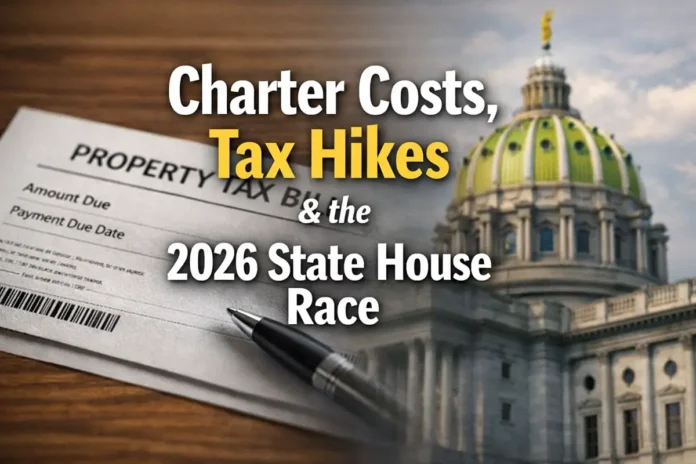
As Bensalem Township School District prepares for a February 18 preliminary budget vote — a procedural step that includes an 8.25% property tax increase scenario driven largely by rising charter school costs — the five-year incumbent faces voters in a district that just completed a historic political realignment.
District officials have warned that charter school special-education payments are projected to nearly double from approximately $7.4 million to $14.6 million, a surge tied in part to a sharp increase in special-education enrollment at School Lane Charter School. That spike has become the single largest driver of the district’s projected shortfall.
While the February 18 meeting does not finalize a tax increase, it sets the stage for whether the district will seek state approval to exceed Pennsylvania’s Act 1 tax limit.
And that puts a state legislator squarely in the conversation.
A Democratic Sweep “Not Seen in Decades”
When Tomlinson won a special election in March 2020 to replace longtime Rep. Gene DiGirolamo, Bensalem’s political composition looked markedly different.
In November 2025, Democrats accomplished what Patch described as “a sweep not seen in decades,” winning three Township Council seats to secure a 3–2 majority and flipping four School Board seats to gain control of the board.
The results marked Bensalem’s first Democratic School Board majority in decades and its first Democratic Township Council majority under the current structure. The shift mirrored broader suburban trends across Bucks County, where education funding and property taxes have become defining issues.
That new political landscape now frames the 2026 state House race in the 18th District, which includes Bensalem Township and Hulmeville Borough.
The Issue She Hasn’t Led On
Since taking office in April 2020, Tomlinson has emphasized public safety legislation, consumer protection, and incremental funding gains for local schools. Her current committee assignments for the 2025–2026 legislative session include:
- Consumer Protection, Technology & Utilities
- Gaming Oversight
- Transportation
- Professional Licensure
She has sponsored or supported legislation on issues such as sextortion prevention (“Lindsey’s Law”) and elder financial exploitation, and she has promoted state grants and school safety funding for Bensalem Township School District.
What has been less visible is leadership on charter school funding reform — the structural issue now driving Bensalem’s budget crisis.
The Pennsylvania House has considered multiple charter reform proposals during her tenure, including:
- HB 2370 (2024) — establishing a lower, flat-rate cyber charter tuition model
- HB 272 / SB 27 — aligning special-education payments more closely with actual costs
- Recommendations from the Basic Education Funding Commission
Tomlinson has not been a primary sponsor of those reform efforts.
As a member of the General Assembly, she has the ability to support or advance legislation that would alter the charter funding formula. But she has not emerged as a leading voice on restructuring that system.
The Math Voters Will See
According to an estimate by advocacy group Children First PA, reforming cyber charter tuition rates and special-education calculations could save Bensalem taxpayers roughly $2.1 million annually — equivalent to an estimated 2–3% reduction in property taxes.
Instead, homeowners are confronting a preliminary budget scenario that includes an 8.25% increase, triggered largely by mandatory charter tuition payments under the state’s PDE-363 formula.
Because the charter payment formula is set by state law, districts have limited short-term control. When enrollment or classifications rise, the remaining levers are raising taxes, cutting programs, or using reserves.
That makes the link between Harrisburg policy and local tax bills unusually direct.
What Allen Must Answer
Tomlinson now faces a Democratic challenger: Bryan Allen, a former Bensalem Township Council member, who announced his candidacy in early February.
Allen has framed his campaign around reducing local property tax burdens and increasing state support for public schools. But broad messaging alone will not settle the charter funding debate.
The charter funding debate now creates an opportunity for both candidates to detail their approaches to a concrete local issue. Tomlinson’s five years in office provide a legislative record on education funding; Allen’s campaign messaging has emphasized state support for schools and property tax relief. How each candidate addresses the charter funding formula specifically — whether by backing existing reform proposals or outlining alternative solutions — will help voters evaluate competing visions for how Harrisburg can affect local tax burdens.
A Test Case for State Legislative Relevance
Unlike many state policy debates that feel abstract, the charter funding formula is:
- Directly calculable — district officials can show the exact cost impact
- Immediately impactful — the February 18 vote begins shaping 2026-27 tax decisions
- Clearly within legislative authority — the formula exists in state law
Whether either candidate can articulate a detailed, achievable plan — and whether voters treat charter reform as a deciding issue — will test how much state legislative races truly matter to local pocketbooks.
The November 4, 2026, election remains months away.
The tax implications, however, are unfolding now.
Editor’s Note on Budget & Charter Cost Reporting
Bensalem Weekly’s coverage of the 2026 school budget is based on:
- Public budget presentations and documents released by the Bensalem Township School District
- Reporting on projected charter school tuition payments, including special education cost projections
- State legislative records related to charter school funding proposals
- Estimates from advocacy and policy organizations, clearly identified as such
The February 18, 2026, School Board meeting is a vote on the district’s Proposed Preliminary Budget, a procedural step that may include a property tax increase scenario but does not, by itself, finalize a tax rate.
All references to the proposed 8.25% tax increase reflect figures presented during district budget discussions and are subject to change as the budget process continues.
Charter school tuition payments are determined by a state-mandated formula (PDE-363). While districts are legally obligated to pay those rates, the formula itself is established in state law and may be revised by the General Assembly.
When citing savings estimates (such as projections from Children First PA), Bensalem Weekly identifies the source of the estimate and does not independently calculate projected savings.
Bensalem Weekly will publish responses from both campaigns as they are received.
Readers with questions about the budget process or campaign positions are encouraged to contact editor@bensalemweekly.com.