
As the Bensalem Township School District Board grapples with a staggering $188 million preliminary budget and a proposed 8.25% tax increase, a single statistic from the board’s January 28th budget recap meeting has begun to echo through the township: Since 2021, 70% of all Bensalem tax increases have gone exclusively to fund charter school special education costs.
While angry voices on social media have quickly aimed their fire at the Bensalem School Board, the timeline suggests a different story. The current board members, who only took office in December 2025 following the November election, have been on the job for less than two months. They aren’t the ones who drove the bus toward this fiscal cliff—they are the ones who were handed the keys just as it ran out of road.
The ‘Statistically Unlikely’ Spike
During the board’s January 28th budget recap meeting, School Director Rachel Fingles revealed the startling statistic that has taxpayers demanding answers: since 2021, 70% of all Bensalem tax increases have gone exclusively to fund the rising costs of charter school special education.
Even more troubling are enrollment numbers presented at the January 14th Business Committee meeting. Director of Special Services Dr. Brian Cohen shared data showing that while the total number of students attending charter schools hasn’t changed dramatically, the number of those students classified as “Special Education” has surged in ways board members are calling “statistically unlikely.”
During the January 14th meeting, board members reviewed data showing one local charter’s special education enrollment jumped from 58 to 109 students in just four months. At a per-student cost that can reach $42,000 for special education services, that 51-student increase represents an additional $2.1 million in annual costs to Bensalem taxpayers.
“I won’t speculate about why that is,” Director Leann Hart said during the meeting, “but it has grown beyond what anyone could have reasonably predicted.”
Board President Stephanie Ferrandez was more direct at the January 14th meeting, calling the enrollment trend “statistically unlikely” and suggesting the charter may be “reclassifying students” specifically to trigger higher reimbursement rates from the district.
Understanding the ‘Double-Dip’
To understand why this is bankrupting Bensalem, you have to understand Pennsylvania’s “PDE-363” funding formula. It’s a system that most experts call “antiquated” and “predatory” toward local districts.
- The Flat-Rate Trap: Unlike traditional public schools, which receive state funding based on the actual cost of a student’s needs, charters are paid a flat “Special Ed” tuition rate by the district.
- The Incentive to Over-Identify: If a student at a charter school needs only minimal support—like a weekly speech therapy session that costs $5,000—the district still has to pay the full “Special Ed” rate, which can be upwards of $42,000 per student in Bensalem.
- The ‘Profit’ Margin: The charter keeps the difference. This creates what education policy experts call a “perverse incentive” to identify students for low-cost special education services while receiving high-cost reimbursement. In essence, the more students classified as “low-cost” special ed, the more funding flows from your property taxes to charter school coffers.
While the current board cannot control which students choose charter schools, the data they’ve been presented suggests a troubling pattern that’s draining district resources at an accelerating rate.
The Math That’s Destroying the Budget
The numbers presented at board meetings paint a stark picture:
- Special education costs: Up nearly $10 million over five years
- Charter school costs: Up $6.2 million over five years
- Fund balance: Dropped from $13 million to a projected $3.5 million this year
- Current budget gap: $6.5 million (could reach $12.1 million depending on state funding)
The administration has already implemented a spending freeze on all non-essential expenditures and has been tasked with presenting a “list of unpleasantness”—potential cuts to programs and staff—to bridge the gap.
A Two-Month-Old Crisis
The current board, seated in December 2025, inherited a reserve fund that had been systematically depleted. What appeared to be a surplus under the previous administration was actually propped up by temporary COVID-relief funding (ESSER) that expired in September 2024, leaving the structural deficit exposed.
Questions remain about the previous board’s handling of the district’s financial trajectory. With the fund balance dropping from $13 million to a projected $3.5 million, and special education costs climbing nearly $10 million over five years, why weren’t taxpayers warned earlier about the structural deficit being masked by temporary COVID relief funds?
The previous Republican-led board had access to the same charter enrollment data now alarming the new Democratic majority—yet there’s no public record of emergency meetings, reform resolutions, or coordinated advocacy efforts during their tenure to address the charter funding crisis before it reached critical mass.
This new board is now stuck in a legal vice. By law, they must pay the charter school invoices sent to them. They cannot negotiate the rates, and they cannot refuse to pay without the state Treasury stepping in to take the money directly from Bensalem’s subsidies. They are effectively “Crisis Managers” for a problem they didn’t create.
The Harrisburg Connection: Legislative Reform Needed
While the School Board can “nickel and dime” their own technology and staff, they cannot change the law. That power lies in Harrisburg.
At a recent legislative breakfast hosted by the Bucks County Intermediate Unit, board members from all 13 local districts gathered to plead for funding reform. According to Director Hart, Bensalem appeared to be the only district without representation from their state representative’s office in attendance.
“The problems driving our budget are not things a school board can simply ‘manage better,'” Hart noted. “They require legislative reform.”
State Representative K.C. Tomlinson represents Pennsylvania’s 18th District, which includes all of Bensalem Township. Tomlinson has previously highlighted her support for education funding and has been endorsed by the Pennsylvania State Education Association.
Bensalem Weekly is reaching out to Representative Tomlinson for her position on charter school funding reform. This story will be updated with her response.
Charter school funding reform has been a contentious issue in Harrisburg for years. While Governor Shapiro proposed an $8,000 flat rate for cyber charters in recent budget negotiations, brick-and-mortar charter funding formulas—like the PDE-363 system affecting Bensalem—remain unchanged.
What Happens Next?
With the February 18th Preliminary Budget Vote looming, the Bensalem School Board is looking at difficult choices. Already, proposals are on the table to eliminate one-to-one Chromebooks for K-2 students, cut classroom technology purchases, and freeze hiring—all while charter school invoices continue to arrive with the force of law behind them.
The district is also weighing a $115-170 million middle school renovation project that could further strain finances.
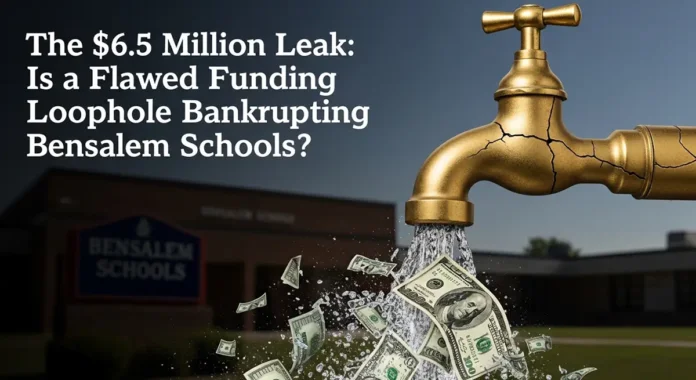
But as long as the charter funding “leak” remains unpatched by state legislators, Bensalem taxpayers are essentially pouring water into a bucket with a massive, state-mandated hole in the bottom.
The current board didn’t create this crisis. But they’re the ones who will have to explain to parents why programs are being cut, class sizes are growing, and property taxes are still going up—all while millions flow out the door to charter schools under a funding formula even education experts call broken.
Frequently Asked Questions
Why is Bensalem’s school budget in crisis?
Charter school special education costs have increased $6.2 million over five years, consuming 70% of all tax increases since 2021. The district also faces a $6.5-12.1 million budget deficit.
What is the PDE-363 formula?
PDE-363 is Pennsylvania’s charter school funding formula that requires districts to pay a flat rate for all special education students, regardless of actual service costs, creating financial incentives for charter schools to over-identify students with low-cost disabilities.
How much will my Bensalem property taxes increase?
The school board is proposing an 8.25% property tax increase for the 2026-27 school year to address the budget deficit.
Can the school board refuse to pay charter schools?
No. Pennsylvania law requires school districts to pay charter school invoices. If a district doesn’t pay, the state Treasury can redirect subsidies directly to charter schools.
When is the Bensalem school budget vote?
The preliminary budget vote is scheduled for February 18, 2026.
Is the Charter Funding Formula Fair? We want to hear from you. Email your thoughts to editor@bensalemweekly.com or join the conversation on our Facebook page.
Read More:
- School Board Recap: Bensalem Faces “Severe” Financial Challenges as Charter and Special Ed Costs Skyrocket
- Township vs. School District: Who actually sets your taxes?
- Meet the 2026 Bensalem School Board
Editor’s Note: This is an ongoing story. Bensalem Weekly has reached out to state and local officials for comment and will continue to follow developments as the district approaches its February 18th preliminary budget vote.