


The Gist
If you are trying to decide whether to rent or buy in Bensalem right now, you are not alone. With mortgage rates hovering near 6% and the median home price pushing $440,000, the monthly cost difference between renting and owning is tighter than it has been in a decade. But the “cheaper” option depends entirely on how long you plan to stay, how much cash you have saved, and whether you are willing to bet on home values continuing to rise.
This is not a moral question. It is a math question—and the answer is different for everyone.
The Numbers: What You Are Actually Paying
Let’s start with the baseline costs for a typical situation in Bensalem as of January 2026.
Scenario 1: Renting a 2-Bedroom Apartment
- Average Rent: $1,750/month (assuming a newer lease; renewals are closer to $1,687)
- Utilities (Tenant-Paid): ~$150/month (electric, internet)
- Renter’s Insurance: ~$20/month
- Total Monthly Outlay: ~$1,920
The Benefits:
- No maintenance costs (landlord’s problem when the furnace dies)
- Predictable monthly cost
- Flexibility to move after the lease ends
- No property tax exposure
The Drawbacks:
- Rent increases at renewal (currently averaging 2% for renewals, but 12% if you move)
- No equity build-up
- No control over renovations or pets (usually)
- You are subject to landlord rules and lease terms
Scenario 2: Buying the Median Bensalem Home
Let’s say you buy a home at Bensalem’s current median price of $440,000 with a 10% down payment ($44,000).
The Breakdown:
- Loan Amount: $396,000
- Interest Rate: 6.0% (30-year fixed)
- Monthly Principal & Interest: ~$2,374
- Property Taxes: ~$800/month ($9,600/year, based on Bensalem’s combined millage)
- Homeowners Insurance: ~$150/month
- PMI (Private Mortgage Insurance): ~$200/month (because you put down less than 20%)
- Maintenance Reserve: ~$200/month (rule of thumb: 1% of home value per year)
- Total Monthly Outlay: ~$3,724
The Benefits:
- Building equity with every payment (even if slowly at first)
- Locked-in housing cost (your mortgage payment will not increase)
- Tax deductions (mortgage interest and property taxes, if you itemize)
- Control over your space (renovate, paint, get a dog)
- Potential appreciation (home values in Bensalem have risen 1.5-3% annually)
The Drawbacks:
- Massive upfront cost ($44,000 down + ~$13,000 in closing costs = $57,000 total)
- You are stuck if you need to move (selling takes time and costs money)
- Property taxes can increase after reassessments
- Maintenance is your problem (new roof? $15,000. HVAC dies? $8,000.)
- Risk of market downturn (though unlikely in Bensalem’s tight inventory)
The “Break-Even” Question
The critical question is: How long do you need to stay for buying to make financial sense?
In a normal market, the rule of thumb is 5 years. That is how long it typically takes for your equity gains to outweigh the transaction costs (realtor fees, closing costs, etc.) of buying and eventually selling.
But Bensalem in 2026 is not a normal market. With only 78 homes for sale and prices projected to rise another 1.5-3%, the math shifts.
The Conservative Estimate (Assuming 2% Annual Appreciation):
- Year 1: You have paid ~$44,688 in interest + taxes, but gained ~$8,800 in appreciation + ~$6,000 in principal. Net cost: ~$29,888.
- Year 3: You have paid ~$134,000 total, but your home is worth ~$466,000 (up $26,000), and you have paid down ~$18,500 in principal. You are starting to break even on equity.
- Year 5: You have paid ~$223,000 total, your home is worth ~$486,000 (up $46,000), and you have ~$32,000 in principal paid. If you sell, after realtor fees (~6%), you walk away with a small profit.
The Renter Over the Same 5 Years:
- Total Rent Paid (assuming 2% annual increases): ~$115,800
- Equity Gained: $0
- Flexibility: High (can move annually)
The Verdict: If you plan to stay in Bensalem for at least 5 years, buying beats renting financially—assuming you can afford the upfront costs and monthly payments. If you might leave in 2-3 years, renting is almost always the smarter financial move.
The “Hidden Costs” Nobody Warns You About
For Renters:
- Moving Costs Add Up: If you move every 2-3 years (common for renters), you pay moving companies, security deposits, application fees, and potential overlap rent. This can easily hit $3,000-$5,000 per move.
- Rent Inflation Risk: Bensalem rents jumped 12% for new leases in 2025. If this trend continues, your “cheap” $1,750 apartment could be $2,200 in 5 years.
For Buyers:
- The First Year Hurts: Almost your entire mortgage payment goes to interest in Year 1. You are paying ~$2,374/month, but only ~$500 is building equity.
- Maintenance is Real: That $200/month estimate? It is not optional. Roofs, furnaces, water heaters, and driveways do not care about your budget. One bad year can cost $10,000+.
- Property Tax Reassessments: Bucks County reassesses property values periodically. If your home has appreciated faster than the county average, your tax bill can jump significantly with no warning.
Who Should Rent in Bensalem?
Rent if you:
- Plan to stay in Bensalem for less than 3 years
- Do not have $50,000+ saved for down payment + closing costs + emergency fund
- Value flexibility (job uncertainty, might relocate, want to test neighborhoods)
- Cannot comfortably afford the ~$3,700/month ownership cost
- Do not want to deal with maintenance, repairs, and property management
Best Renter Strategy:
- Renew your lease whenever possible (2% increase beats 12%)
- Look for apartments near SEPTA stations or commercial corridors for convenience
- Negotiate lease renewals—landlords would rather keep you than find new tenants
- Save aggressively while renting to build a down payment if you eventually want to buy
Who Should Buy in Bensalem?
Buy if you:
- Plan to stay in Bensalem for at least 5 years (ideally 7+)
- Have $50,000-$60,000 saved (down payment + closing costs + 6-month emergency fund)
- Can comfortably afford $3,700/month in total housing costs
- Want to lock in your housing cost and avoid rent inflation
- Value control over your living space (renovations, pets, yard)
Best Buyer Strategy:
- Put down 20% if possible to avoid PMI (~$200/month savings)
- Target turnkey homes—you do not have the cash buffer for major repairs right after buying
- Consider Neshaminy Valley or Millbrook neighborhoods (see our Housing Report for details)
- Lock in your rate now—experts expect rates to stay in the 6% range through 2026
The “Wild Card” Factors
1. The Lock-In Effect Works Both Ways
Right now, homeowners with 3-4% mortgages are not selling, creating the inventory squeeze. But if you buy at 6% today and rates drop to 4% in 3 years, you can refinance. Renters get no such benefit.
2. The Casino Grant
Bensalem homeowners get a $300 annual casino grant from Parx (see our tax guide). That is effectively $25/month off your ownership cost. Renters do not get this.
3. The “Opportunity Cost” of Your Down Payment
If you put $44,000 into a home, you cannot invest it in the stock market. Historically, the S&P 500 averages ~10% annual returns. Your home might only appreciate 2-3%. Over 10 years, that $44,000 in the stock market could grow to ~$114,000. In your home, it might only grow to ~$57,000 (after appreciation and principal paydown). This is the silent cost of homeownership.
The Bottom Line
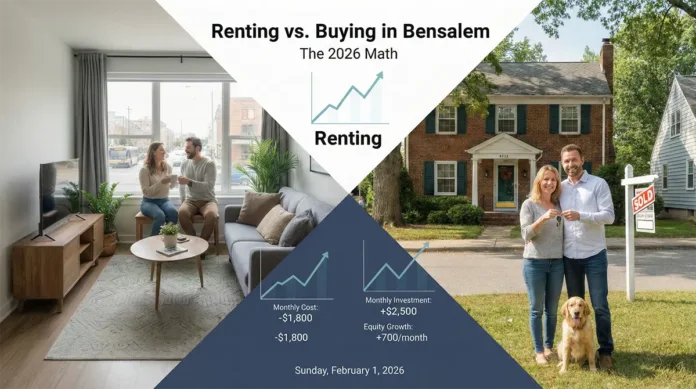
In Bensalem in 2026, renting costs about $1,920/month, while buying the median home costs about $3,724/month. That is a $1,800/month difference—or $21,600 per year.
But over 5+ years, the buyer builds ~$50,000+ in equity (through appreciation and principal paydown), while the renter builds $0. If you can afford the upfront costs and plan to stay, buying wins. If you need flexibility or cannot stomach the monthly payment, renting is not “throwing money away”—it is paying for flexibility and simplicity.
The real answer? Run your own numbers. Plug in your actual rent, your actual down payment, and your actual timeline. The math will tell you what to do.
And if you are still not sure, rent for another year and save more. The Bensalem market is not going anywhere.
Frequently Asked Questions
Q: Is it cheaper to rent or buy in Bensalem right now?
A: Renting is cheaper month-to-month (~$1,920 vs ~$3,724), but buying builds equity over time. The break-even point is around 5 years if home values continue rising 2-3% annually.
Q: How much do I need saved to buy a home in Bensalem?
A: For a $440,000 home with 10% down, you need approximately $57,000 total: $44,000 down payment + $13,000 closing costs. Plus, keep a 6-month emergency fund separate.
Q: What are current mortgage rates in Bensalem?
A: As of January 2026, 30-year fixed mortgage rates in Pennsylvania are averaging 5.875-6.29%, depending on your credit score and down payment.
Q: Will Bensalem home prices drop soon?
A: Unlikely. With only 78 homes for sale and high demand, prices are projected to rise 1.5-3% in 2026. See our Housing Report for details.
Q: Can I afford to buy in Bensalem on the median household income?
A: Bensalem’s median household income is $81,616. To comfortably afford the median home ($440K), you’d need an income of around $100K+. Many buyers are stretching or buying below the median price point.
Q: Should I wait for interest rates to drop before buying?
A: Maybe. But remember: if rates drop, demand will surge, and prices will rise. You might end up paying more for the house even with a lower rate. The saying goes: “Marry the house, date the rate”—you can always refinance later.
Q: What’s the typical down payment for first-time buyers in Bensalem?
A: Many first-time buyers put down 5-10%. FHA loans allow as little as 3.5% down, but you’ll pay PMI until you reach 20% equity.
Related Articles:
- The 2026 Housing Report: Why Bensalem Prices Aren’t Dropping
- The Bensalem Tax Guide: What You Pay & What You Get Back
- Bensalem PA Population 2026: Demographics, Density & Growth Trends
Last Updated: January 21, 2026
Disclaimer: This analysis uses median prices and average rates as of January 2026. Individual circumstances vary. Consult with a financial advisor and mortgage professional before making housing decisions. Bensalem Weekly is not a financial advisor.